InTIME21

InTIME21

Tuesday, 2 February 2016

Meeting in Finland

In January 2016 it was time for our next meeting organized in Pietarsaari, Finland.

The meeting was held in two “waves”: The teachers arrived on Thu 14th and left the following Monday while the second wave of students  and accompanying teachers arrived on Saturday evening leaving the following Friday. That meant that the whole group of teachers and students + all the local teachers and students (about 70) spent the greatest day outdoors in Nanoq (The arctic museum) and Merilä (the congregation camp center) also enjoying the beautiful winter landscape and outdoor activities eg. walking on the ice or in the silent forest. One aspect of sustainable development, the key issue of Pietarsaari meeting, is the cultural aspect and that was implemented in our day in the museum and in nature.


During the teachers and coordinators´ meeting they had eg. a chance to discuss the best teaching practices and ideas considering sustainable development, listen to the lectures about Finnish ECO-school in Pietarsaari and Nature school in the neighbor city, Kokkola, and of course plan the future of the whole project. As promoting good health is also an essential  part of sustainable development, the teachers were offered to try yoga and even test their limits - and sure they did: Most of the teachers were brave enough not only to sit in the hot sauna but also take a dip in the freezing ocean at Strandis.  At least the dinner in Ädelbragd in Oravainen on Sunday evening was quite an experience for our foreign teachers: the food offered in the 18th century style and the vividly told details about the fight in Oravainen as part of the Finnish war will probably stay in their minds for a long time.


------------------------------------------------------------------------------------------------------

The first day of the students´ week was spent in Merilä and as they had arrived late the previous evening, the day was also spent to get to know each other a bit better.

There was a lot of laughter, joy and excitement (and snow fights) in the air as the students and teachers enjoyed this perfect though a bit chilly day outdoors. The weather was almost perfect the whole week: the temperatures varied between -15 to -30, but the cold was not a problem: there were hardly any complaints and most of the people were well informed and well equipped to face the chilly weather.


On different afternoons the students and teachers tried skating in the skating rink, skiing in the school park, took a Nordic walking –tour to music café After Eight and finally sledging in almost freezing temperatures. For most people all the activities were new and exciting, but there were also a few who had tried some of them earlier.


On Monday the actual work considering environmental issues and sustainable development got started. After discussing a very touching HOME-movie (students had watched it at home) and planning posters based on it, it was time to get to work with the main theme during the week and form the international groups. The work started by watching the videos made by each country trying to gather possible environmental problems and choosing one of them to be solved. The students were offered ideas how to think as creatively as possible and the model that they used to analyse the problem and the reasons behind it was called Fishbone analysis created by Japanese Kaoru Ishikawa. The aim was to create 2 different solutions to the problem: both realistic and the futuristic one, and when Thursday finally arrived, we were able to see unbelievably creative solutions and lively presentations, because also the form of the presentation was open.


In addition to this project lasting the whole week the students´ knowledge about the environment and the importance of nature preservation and sustainable development definitely increased when they had a chance to visit Ekorosk, an exceptional waste disposal facility in Pietarsaari. On Wednesday morning the students gave their individual, ecological promises to reduce their ecological foot print and all of them were and are to be seen by everybody else on a big blanket.
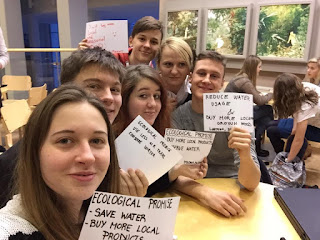


Considering the cultural aspect of sustainable development, we wanted the students to present and teach something small from their own home country: That was organized in the form of a short cultural assembly on Thursday morning. 


The grand finale to the whole week was the farewell party and Finnish evening on that evening where the students and teachers had a chance to taste typical Finnish treats, listen to and sing Finnish music, play some games and of course, meet Santa himself!


During the week and project tasks but especially in other activities (ice swimming, evening at school and hanging around together) they created long-lasting friendships and that is as important as any end product of the week – if even more important.

Teija Kauppinen
English teacher
Pietarsaaren lukio

Friday, 22 January 2016

When we arrived back from Spain, we got the idea of presenting entrepreneurship work we did there to our fellow classmates. So we got the necessary materials like the questionnaire and the canvas and got to work. We also did the six thinking hats technique. They divided themselves into groups and got to work. They took the tasks seriously and at the end of the two periods they presented their work to others. We did this in two classes.


Janez Vončina & Gašper Rejc

Sunday, 6 December 2015

Meeting in Barcelona, Spain

For us, Slovenians, the meeting started on Sunday. After a ride from Slovenia to Treviso, Italy we took a plane to Barcelona. With our spirits high, we arrived later in the afternoon meeting our hosts at the enormous airport of Barcelona. That day, we just settled in our newfound homes and went out for a dinner with some other students from the exchange and we experienced our first long, sandwich full Spanish dinner.

 Pictured: Working with the 6 Thinking hats techinque

The next day however, our work started. After a brief introduction about that week's plan, we also got the chance to get to know each other. The work started in groups made up of students of different nationalities. We talked about what it takes to be an entrepreneur and what skills matter. After some brainstorming, we hopped on the metro to CaixaLab. This is an organisation where we were presented with a guided tour of some important Spanish entrepreneurs, creative thinking and thinking outside of the box. We had a lot of interactive "games" where we tried to solve a problem in a, if possible, the most creative way. We saw how some everyday product is a really simple solution to a (an obvious) problem. We also had our first glimpse of a business plan and did some work with that.

Over the course of the following days, we started working in our groups more intensively. We all wrote down our problems and possible solutions to them. With a method called 6 Thinking Hats, we found out which problem and solution could potentially be the best to try and solve. After we all agreed on one, we went to work. We perfected the idea and assigned roles to work towards it. Each did his part and we all helped each other if needed. With our business plan complete we also made a presentation and presented our project to others at the end of the week. I can safely say that all the groups completed their projects, but ours was definitely top notch!

So to draw the line, for entrepreneurship the most important skill to have is creative thinking. But you also need to be hard working, patient and ready to meet different people who you will need to help your idea become a reality. I think that this project really taught me how to work better as a group and to be ready to listen do different inputs and work them into what you do. Sometimes a group's vision really helps you to make something better for a majority in case you are limited by your vision.

And now to draw the line for the social aspect of the meet. In the afternoons, after the work was over our Spanish friends usually took us for a walk around the city. We saw many monuments of Barcelona and tasted some Catalonian and Spanish cuisine. We took part in many different activities. The week was fun for everybody as we met many people and made friendships and the most important thing to take away from the week is the experience. Experiencing the city, the culture and the people. I think all the students will hold this week in good memory.


Janez Vončina

Monday, 29 June 2015

Peer Education Day in Finland

Pietarsaaren lukio had a Peer Education Day on 22nd of April 2015 as well as many other partner schools. A local newspaper Pietarsaaren Sanomat published an article, and this is a short version of it.


Experiental Peer education day in Pietarsaari Upper Secondary School

One of the teaching- and learning  experiments agreed in InTIMe21 -project was the Peer education day. According to American pedagog, Edgar Dale, and his learning pyramid we learn only 5% by listening to a lecture, 10 % by reading, 50% by discussing but 90% by teaching ourselves. Based on these results we organized a peer education day when the students were able to teach each other and also learn new things themselves.


The basis for this experiment was set in Århus, Denmark last autumn when four students from Pietarsaari Upper Secondary School were able to test this method in practice and teach the lower comprehensive pupils there.


On Wednesday 22nd April the whole school participated in the event in Pietarsaari.
The students who were willing to teach planned the session themselves. All of them had an assisting teacher who was there to help if needed and who checked the final lesson plan. But the students took care of the actual teaching session all by themselves.

- The experience was awesome! It´s great to teach things you yourself are interested in. At the same time you feel joy and satisfaction to be able to teach things that mean a lot to you, says the French teacher, Aleksi Heikkilä, the first grader in Pietarsaari Upper Secondary School.


The students were also satisfied. – When your peers are teaching, they know how to approach the students, says the second grader, Laura Lepistö.

During the day the students taught all kinds of skills: All the students created a Europass, the document where you can collect all your language skills, studies and diplomas, which may be helpful in applying to a school or for a job. 


In additional 15 workshops the students had the possibility to learn eg. Japanese, programming, baking, playing the piano, acting and volleyball. 
- You should have a day like this on every course, wishes the first grader, Essi Rimmi.


The documentary crew consisting of students was there to save the whole day on video and photos. The history teacher and careers counselor, Heimo Martikainen, followed the day through the lens as well.

-It´s great to see so many potential future teachers who were able to take teaching seriously enough but also humouristically. I believe that many of the novices will end up becoming real teachers in the future, Martikainen predicts.


At the end of the day the whole school gathered in the sports hall where Sofia Kujala, Markus Ojajärvi, Jenna Tuomaala and Vivi Wideman taught the Happy dance for the rest of the school. These students had themselves learned the choreography and taught it to the pupils in Denmark. The hips were moving, hands were clapping and faces were glowing as both teachers and students were learning as equals.

The whole school had an opportunity to experience a new kind of day and feel the power and joy of peer education. With this day in our heads and hearts we are eager to continue towards new, creative teaching- and learning methods.

Text: Tiina Stara
Translation: Teija Kauppinen

Saturday, 23 May 2015

SLOVENIA - PEER EDUCATION DAY 


On 22nd April (earth day) we had a peer teaching day and earth day on our school. Students were happy to lecture their schoolmates at different subjects (Biology, German, Physics, English...).  Everyone was able to choose his/her own theme. 
Maruša and I had a peer teaching lesson in our German class and we were talking about Earth Day. It was a nice and interesting experience. I have to say that everything is different when you stand in front of the board and you are trying to explain something to your friends, especially in language that we are not fluent in. In some moments it’s really hard too.  We were happy to see that our classmates were listening to us. Students who were present at this class said that it was interesting experience for them also, they said that classes were better, because students were able to talk about things that they like and introduce them to other students. Also, everyone was more relaxed and asked about things they didn’t know. I hope this day becomes a tradition, or maybe that classes like this happen more often, because it was definitely a really interesting experience.

Mojca Lukan

Meeting in IDRIJA, Slovenia

ROUND TABLE on competences


In our school, we organized a discussion using the technics of a round table as a part of the Erasmus+ meeting that we hosted at that time. This means teachers and young people from seven different countries – Slovenia, Poland, Finland, Denmark, Austria, Spain and Italy participated.  Our topic to discuss was what competences do young people need in their future work life? Therefore, for more actual information we invited representatives of some local companies like Kolektor, Hidria and Ydria Motors. We asked these representatives and the young people from every country to search for information in their towns that we’d be able to compare our experience with theirs. The questions we prepared for them were: do you think young people are taught these competences at school? Any suggestions how they could develop the competences they don’t have? Would you be willing to cooperate with schools to promote the development of these skills and competences? What aid do you offer to young people, in regard to future employment? In what areas do you offer employment to young people? Do you believe young people have a place in the town? What are your thoughts on the brain drain in your town?  What measures do you believe should be taken to combat the issue? 


Austria set out that it’s important to present your own opinion, think critical, have negotiating skills and to make compromises in critical situations. Their suggestions how to improve these skills were writing more essays on your own would prepare you to present certain topic and be critical about it, teachers should focus more on teaching us how to be critical and they also think that it would be good to cooperate more with some local companies.

Denmark presented us a video, in which they went around their town and interviewed some representatives of local companies.

In Finland, they found out that some of the important skills are flexibility, empathy, patience, good manners and the ability to solve problems. They think that the best solution would be to get a job and learn these skills there. In their town, local supermarkets offer 14 days of work practice.
Poland pointed out being responsible for your own actions, to be able to work in groups, to know how to use different technology (which is not such a problem in our generation), to be flexible to all kinds of different situations and people and of course to be happy with what you do. They said that school doesn’t teach us how to be adults but they are only putting facts, we’ll need on tests, in our head. In school, we actually learn something important and that is that we need to be responsible and give away school papers on time. And one thing we all agreed on in that learning languages is important.
Spain thinks that creativity, communication, being self-critic and languages are the most valued competences there. Their argument was that we do learn competences in school but only in theory and we don’t use them in practice, a suggestion was that we should have some exercises of real life situations which we would try and solve. Students there are also interested in cooperating with local companies.

In following conversations we discussed how to gain those competences with representatives of our local companies and they pointed out what competences they are looking for. The answers were quite similar and in conclusion flexibility, job satisfaction, motivation and passion are top four competences. They can be gained with hobbies, volunteer work and being involved in projects like Erasmus+. Our companies are also offering work practice, summer jobs, scholarships and Kolektor for example is also cooperating with factory in Germany. The main problem is that those jobs base on technical school background, which leads us to closure that finding job for a technician, is much easier in Idrija. 

We also agreed that ‘brain drain’ can be considered as a problem. At first young people who live in smaller towns go to bigger cities to study, get certain knowledge. Lots of them also go abroad to earn some experiences. Some of them go just because they like to travel, explore foreign countries and that’s okay. But in their hometowns they are often not able to find job and that’s what is keeping them away. They find employment in big town and they stay there. Now the big question is what we can or better said should do to prevent migrations of young intellects? In this case we should all be inspired by Denmark. As students said: ’’After education in big towns they move back to smaller ones. They also get paid for school so it’s easier to have small apartment in town.’’ And are they afraid not to get job? NO, because if they don’t get job they get support from the state so they can find one. So in Denmark if you are 18+ and you are educated you get some amount of money that helps you to find job.

After that topic we jumped to creativity, in our opinion one of most interesting parts of debate. For the start we asked ourselves what creativity actually is. We got different responses by students and teacher that creativity in their opinion is graffiti, painting, blogs, being yourself…And none of them was wrong. In words of Italian student CREATIVITY IS A WAY TO BE IMMORTAL and according to representative of Kolektor creativity is about finding new ways of solving problems, to improve existing solutions not just creating new products. We were also reminded that we often confuse creativity and technology. Everyone can make a movie with their phone but creativity takes time and in the end you don’t need expensive equipment to express yourself. Teachers also pointed out that we can’t be creative on command and here is the point where we, students agree with them. In our opinion school doesn’t give us enough space or enough freedom to express ourselves. Teachers give us thousands of definitions every day that we have to learn by heart and we don’t even try to understand half of them because we don’t discuss them, we don’t emphasize their meaning. As simple as that we opened a new topic that left lots of open questions so it may be excellent starting point of another round table.

For the end we saved question: ’’Are we active enough?’’ Well it depends, but for sure students and teachers who participate in InTime21 and similar projects are active and willing to change something. With collaborating in these kind of activities we don’t just gain competences, we also get prepared for future life and obtain certain knowledge that school can’t give us. With these words in mind we are all anticipating the next meeting in Spain. 
Špela Bratuš & Carolina Petrič


Meeting in IDRIJA, Slovenia

Exchanging good practice - Socratic seminar


On the second day of our conference the teaching staff attempted to present to us the new, more innovative and engaging methods of teaching that have the potential to increase the participation of students during the classes themselves as this specific method of teaching involved a debate.
Listening to the instructions

However, there is a slight twist in the “plot” of this debate, while the usual debates have a narrator who asks question and leads the conversation towards the conclusion this debate didn’t have a “leader” of the conversation. In the beginning the teacher first lied down some ground rules for the debate which were quite basic such as: “no insulting” and “no talking when others speak” but on the other hand there was one rule which got my attention the most: the students cannot raise their hands to get their right to speak and without any leadership that had the potential to cause some trouble in the conversation.

Afterwards we were all given a short poem and were asked to read it. Although I felt quite confident that I understood the poem myself, I wanted to make sure that others did as well and asked if anyone of my fellow students would mind if we read the poem out loud. That turned out into a good idea and with every participant in the conversation aware of the topic we are discussing, we started the debate.

Naturally, there was some confusion at the beginning and the conversation jumped between different points, none of which were properly discussed. But towards the end each one of us got the feeling of our own strengths and weaknesses in this debate and the analyze of the poem went quite well.

In the end the teacher gave each one of us feedbacks on how we could improve ourselves and in my opinion that is the best part of this exercise as the students in the end get the feedback they need to improve themselves in the future.


To conclude, I believe that in the opinion of most participants the exercise turned out quite successful but without proper guidance any debate might stray off its original purpose and needs at least a bit of control from the side of the teacher.
Aljaž Seljak