InTIME21

Sunday, 23 April 2017

Friday, 21 April 2017
ERASMUS+ TEACHER’S MEETING Mo, 3.10.2017 to Fr, 7.10.2017
After intensive preparation work we welcomed
colleagues from Slovenia, Italy, Denmark, Finland, Poland and Spain at our
school. Nine months after the last meeting in Pietarsaari, Finland, there was a
lot to catch up on.
The topic of the meeting in Vienna was: “Web 2.0 Tools and Cultural Diversity“.
On Tuesday, October 4th, our guests were welcomed with a welcome song of our school choir.
 |
Welcome song
by our school choir
|
After the
official opening of the meeting by Birthe Witt Jason, the project coordinator
from Denmark, the first workshop on Web 2.0 started.
 |
Opening of
meeting by Birthe Witt Jason
An expert from a neighbouring grammar school, Josef
Buchner, introduced methods and strategies to use Web 2.0 tools in class. He
focussed on the tool of the “Flipped Classroom“.
In the afternoon we had a guided tour through a museum
in an old church. The tour is called „Dialogue in the Dark“ and the guides are
blind or visually impaired, which makes the tour very authentic and provides
insights into how blind people cope with the challenges of everyday life.
In order to make our guests acquainted with the heart
of Vienna, we used a Web 2.0 tool called “Actionbound“, which takes you on an
online scavenger hunt.
On Wednesday, October 5th, our guests were welcomed by
our head teacher Dagmar Kerschbaumer and were guided through the school
building by students of our school.

Welcome by
headteacher D. Kerschbaumer
In a workshop, our guests reported on the activities
which had already taken place at their schools and which impact the work of the
Erasmus+ Teams had on their schools.
After lunch, our colleagues had a chance to experience
Vienna’s public transport system when we travelled from Heustadelgasse to a
hilly part of Vienna called Grinzing, which is well-known for its vineyards and
wine taverns. Although it was a cold and windy day, we were all motivated to
hike to the circle of trees called “Lebensbaumkreis“, corresponding the signs
of the zodiac.

Hiking in
Grinzing
The last day of the teachers‘ meeting focussed on
preparing the workshops for the approaching students‘ meeting in November/December
2016 on “Cultural Diversity“.
Our farewell dinner was, of course, at a “Heurigen“, a
wine tavern typical of this area and of Vienna.
|
Friday, 22 April 2016
Earth Day in Pietarsaaren lukio
Pietarsaaren lukio participated in Earth Day by small but significant eco deeds. The idea of the day was to teach ecological thinking within the lessons and by consuming less electricity and fossil fuels.
Ride your bike to school!
The students and teachers were asked to ride their bikes to school instead of driving their cars or getting a ride. The idea was to come to school with the person’s own energy, so in addition to biking, it was recommended to walk, rollerblade or skateboard to school. Many students and teachers took the chance as they do every school day throughout the year despite the weather.

Ecologigal topics in class
All the teachers were asked to teach ecological values in their own subjects. For instance, on an English lesson, the topic of consuming less was discussed.


Switch off the light, please!

A great idea, which the students came up with, was to study without any electricity. In a modern school, it is a little bit difficult, but at least it was partially carried out. In physics, biology and English, the teachers decided to switch off the lights on the lesson. On a chemistry lesson, the teacher only wrote with a chalk on a black board with the lights switched off. A sunny spring day made it possible.
 This is about changing attitudes with small steps, says Anna-Maija Lyyra, the biology and geography teachers. - Everybody can do his share quite easily.
Marja Seppälä, the religion teacher took the students on an Apostolic walk in order to take a look at the religious places of the town. In the beginning of the lesson, they also made an experiment of surrounding a tree holding each others hands. On a philosophy lesson, Marja took the students to meet a tree and have a dialogue in a Buberian way.
Green clothing

Many students honored the theme by dressing in green. Different shades of green reminded everyone of the Earth Day and the importance and necessity to stop the climate change and to protect nature.


Tuesday, 2 February 2016
Meeting in Finland
In January 2016 it was time for our next meeting organized
in Pietarsaari, Finland.
The meeting was held in two “waves”: The teachers
arrived on Thu 14th and left the following Monday while the second
wave of students and accompanying
teachers arrived on Saturday evening leaving the following Friday. That meant
that the whole group of teachers and students + all the local teachers and
students (about 70) spent the greatest day outdoors in Nanoq (The arctic
museum) and Merilä (the congregation camp center) also enjoying the beautiful
winter landscape and outdoor activities eg. walking on the ice or in the silent
forest. One aspect of sustainable development, the key issue of Pietarsaari
meeting, is the cultural aspect and that was implemented in our day in the
museum and in nature.


During the teachers and coordinators´ meeting they had
eg. a chance to discuss the best teaching practices and ideas considering
sustainable development, listen to the lectures about Finnish ECO-school in
Pietarsaari and Nature school in the neighbor city, Kokkola, and of course plan
the future of the whole project. As promoting good health is also an essential part of sustainable development, the teachers
were offered to try yoga and even test their limits - and sure they did: Most
of the teachers were brave enough not only to sit in the hot sauna but also
take a dip in the freezing ocean at Strandis. At least the dinner in Ädelbragd in Oravainen
on Sunday evening was quite an experience for our foreign teachers: the food
offered in the 18th century style and the vividly told details about
the fight in Oravainen as part of the Finnish war will probably stay in their
minds for a long time.
------------------------------------------------------------------------------------------------------
The first day of the students´ week was spent in
Merilä and as they had arrived late the previous evening, the day was also
spent to get to know each other a bit better.
There was a lot of laughter, joy and excitement (and
snow fights) in the air as the students and teachers enjoyed this perfect
though a bit chilly day outdoors. The weather was almost perfect the whole
week: the temperatures varied between -15 to -30, but the cold was not a
problem: there were hardly any complaints and most of the people were well
informed and well equipped to face the chilly weather.


On different afternoons the students and teachers
tried skating in the skating rink, skiing in the school park, took a Nordic
walking –tour to music café After Eight and finally sledging in almost freezing
temperatures. For most people all the activities were new and exciting, but
there were also a few who had tried some of them earlier.


On Monday the actual work considering environmental
issues and sustainable development got started. After discussing a very
touching HOME-movie (students had watched it at home) and planning posters
based on it, it was time to get to work with the main theme during the week and
form the international groups. The work started by watching the videos made by
each country trying to gather possible environmental problems and choosing one
of them to be solved. The students were offered ideas how to think as creatively
as possible and the model that they used to analyse the problem and the reasons
behind it was called Fishbone analysis created by Japanese Kaoru Ishikawa. The
aim was to create 2 different solutions to the problem: both realistic and the
futuristic one, and when Thursday finally arrived, we were able to see
unbelievably creative solutions and lively presentations, because also the form
of the presentation was open.


In addition to this project lasting the whole week the
students´ knowledge about the environment and the importance of nature
preservation and sustainable development definitely increased when they had a
chance to visit Ekorosk, an exceptional waste disposal facility in Pietarsaari.
On Wednesday morning the students gave their individual, ecological promises to
reduce their ecological foot print and all of them were and are to be seen by
everybody else on a big blanket.
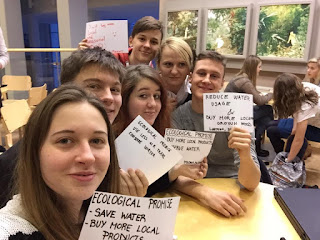


Considering the cultural aspect of sustainable
development, we wanted the students to present and teach something small from
their own home country: That was organized in the form of a short cultural
assembly on Thursday morning.

The grand finale to the whole week was the farewell party and Finnish evening on that evening where the students and teachers had a chance to taste typical Finnish treats, listen to and sing Finnish music, play some games and of course, meet Santa himself!


The grand finale to the whole week was the farewell party and Finnish evening on that evening where the students and teachers had a chance to taste typical Finnish treats, listen to and sing Finnish music, play some games and of course, meet Santa himself!

During the week and project tasks but especially in
other activities (ice swimming, evening at school and hanging around together)
they created long-lasting friendships and that is as important as any end
product of the week – if even more important.
Teija Kauppinen
English teacher
Pietarsaaren lukio
Teija Kauppinen
English teacher
Pietarsaaren lukio
Friday, 22 January 2016
When we
arrived back from Spain, we got the idea of presenting entrepreneurship work we
did there to our fellow classmates. So we got the necessary materials like the
questionnaire and the canvas and got to work. We also did the six thinking hats
technique. They divided themselves into groups and got to work. They took the
tasks seriously and at the end of the two periods they presented their work to
others. We did this in two classes.


Janez Vončina & Gašper Rejc
Sunday, 6 December 2015
Meeting in Barcelona, Spain
For us, Slovenians, the meeting started on
Sunday. After a ride from Slovenia to Treviso, Italy we took a plane to
Barcelona. With our spirits high, we arrived later in the afternoon meeting our
hosts at the enormous airport of Barcelona. That day, we just settled in our newfound
homes and went out for a dinner with some other students from the exchange and
we experienced our first long, sandwich full Spanish dinner.
 Pictured: Working with the 6 Thinking hats techinque
The next day however, our work started. After a
brief introduction about that week's plan, we also got the chance to get to
know each other. The work started in groups made up of students of different
nationalities. We talked about what it takes to be an entrepreneur and what
skills matter. After some brainstorming, we hopped on the metro to CaixaLab.
This is an organisation where we were presented with a guided tour of some
important Spanish entrepreneurs, creative thinking and thinking outside of the
box. We had a lot of interactive "games" where we tried to solve a
problem in a, if possible, the most creative way. We saw how some everyday
product is a really simple solution to a (an obvious) problem. We also had our
first glimpse of a business plan and did some work with that.
Over the course of the following days, we
started working in our groups more intensively. We all wrote down our problems
and possible solutions to them. With a method called 6 Thinking Hats, we found
out which problem and solution could potentially be the best to try and solve.
After we all agreed on one, we went to work. We perfected the idea and assigned
roles to work towards it. Each did his part and we all helped each other if
needed. With our business plan complete we also made a presentation and
presented our project to others at the end of the week. I can safely say that
all the groups completed their projects, but ours was definitely top notch!
So to draw the line, for entrepreneurship the
most important skill to have is creative thinking. But you also need to be hard
working, patient and ready to meet different people who you will need to help
your idea become a reality. I think that this project really taught me how to
work better as a group and to be ready to listen do different inputs and work
them into what you do. Sometimes a group's vision really helps you to make
something better for a majority in case you are limited by your vision.
And now to draw the line for the social aspect
of the meet. In the afternoons, after the work was over our Spanish friends
usually took us for a walk around the city. We saw many monuments of Barcelona
and tasted some Catalonian and Spanish cuisine. We took part in many different
activities. The week was fun for everybody as we met many people and made
friendships and the most important thing to take away from the week is the
experience. Experiencing the city, the culture and the people. I think all the
students will hold this week in good memory.
Janez Vončina
Monday, 29 June 2015
Peer Education Day in Finland
Pietarsaaren lukio had a Peer Education Day on 22nd of April 2015 as well as many other partner schools. A local newspaper Pietarsaaren Sanomat published an article, and this is a short version of it.

In additional 15 workshops the students had the possibility to learn eg. Japanese, programming, baking, playing the piano, acting and volleyball.


Experiental Peer
education day in Pietarsaari Upper Secondary School
One of the teaching- and learning experiments agreed in InTIMe21 -project was
the Peer education day. According to American pedagog, Edgar Dale, and his
learning pyramid we learn only 5% by listening to a lecture, 10 % by reading,
50% by discussing but 90% by teaching ourselves. Based on these results we
organized a peer education day when the students were able to teach each other
and also learn new things themselves.

The basis for this experiment was set in Århus,
Denmark last autumn when four students from Pietarsaari Upper Secondary School
were able to test this method in practice and teach the lower comprehensive
pupils there.


On Wednesday 22nd April the whole school participated
in the event in Pietarsaari.
The students who were willing to teach planned the
session themselves. All of them had an assisting teacher who was there to help
if needed and who checked the final lesson plan. But the students took care of
the actual teaching session all by themselves.
- The experience was awesome! It´s great to teach
things you yourself are interested in. At the same time you feel joy and
satisfaction to be able to teach things that mean a lot to you, says the French
teacher, Aleksi Heikkilä, the first grader in Pietarsaari Upper Secondary
School.

The students were also satisfied. – When your peers
are teaching, they know how to approach the students, says the second grader,
Laura Lepistö.
During the day the students taught all kinds of
skills: All the students created a Europass, the document where you can collect
all your language skills, studies and diplomas, which may be helpful in
applying to a school or for a job.
In additional 15 workshops the students had the possibility to learn eg. Japanese, programming, baking, playing the piano, acting and volleyball.

-It´s great to see so many potential future teachers
who were able to take teaching seriously enough but also humouristically. I
believe that many of the novices will end up becoming real teachers in the
future, Martikainen predicts.

At the end of the day the whole school gathered in the
sports hall where Sofia Kujala, Markus Ojajärvi, Jenna Tuomaala and Vivi
Wideman taught the Happy dance for the rest of the school. These students had
themselves learned the choreography and taught it to the pupils in Denmark. The
hips were moving, hands were clapping and faces were glowing as both teachers
and students were learning as equals.
The whole school had an opportunity to experience a
new kind of day and feel the power and joy of peer education. With this day in
our heads and hearts we are eager to continue towards new, creative teaching-
and learning methods.
Text: Tiina Stara
Translation: Teija Kauppinen
Subscribe to:
Comments (Atom)